
 Robotic Surgery Unit
  DELIVERY AT THE CLINICA ROTGER
  Neurological Institute - Olabe Neurosurgery


The Da Vinci Xi Robot offers multiple advantages in terms of precision, image quality with magnified and three-dimensional vision. The robotic arms perfect the doctor’s pulse and thanks to their ability to rotate 360° they allow access to anatomically complex areas, providing better guarantees in terms of patient safety in different surgical specialities such as Urology, Gynaecology, General Digestive Surgery and Otolaryngology.
Prostate surgery with robotic assistance
One of the interventions with the most scientific evidence and medica consensus regarding its proven benefits is prostate cancer surgery with a robotic approach. According to Dr. Marta de la Cruz, “the Robot allows the removal of prostate cancer with a minimally invasive technique, more precise way than other options, thus reducing the risk of adverse effects such as incontinence and erectiledysfunction that negatively affect the quality of life of patients.
Advantages of robotic surgery in prostate cancer surgery
- Reduced risk of complications
- Less bloodloss andlessneed for trans
- Reduced risk of lnfections
- Fewer days with catheter
- Reduced pain
- Shorter hospital stay
- Quicker retum to normal activity
- Better preservation of erectile function and control of urination

Robotic Gynaecology lnterventions
Dr. Anna Torrent, explains that in Robotic Gynaecology interventions: “The patient suffers less trauma to their tissues, generally also less blood loss and consequently, experiences a decrease in postoperative pain requiring fewer days of hospital stay”.
The Robotic Surgery Unit at Clínica Rotger and Hospital Quirónsalud Palmaplanas is the only one in private healthcare in Mallorca that has a Da Vinci Xi Robot anda team of specialísts with extensive experience in handling the robot.
Pioneerin interventions in general digestive surgery
At Clínica Rotger, Dr. Antonio de Lacy was the first specialist to perform highly complex surgery with the Da Vinci Xi robot. Doctors José María Muñoz and José Manuel Olea, for their pan, have performed pioneering robotic approaches in the Balearic Islands, such as the first robotic TAMIS, which allows for robot-assisted surgery on rectal cancer through the anus. As well as the first roboric gastric bypass in the islands, or the first approach to achalasia using robotic surgery.
Robotic surgery for the management of sleep apnoea
A patient is considered to have Obstructive SleepApnoea Syndrome (OSAS) when during the night he or she stops breathing repeatedly for 10 or more seconds. Dr. Pedro Sarria of Clínica Rotger’s Otorhinolaryngology service reminds us that: “Sleep apnoea has very important implications in terms of the quality of sleep, but it can also affect the cardiovascular, neuropsychic and metabolic levels”. The sleep apnoea intervention consists of bringing forward the muscles at the base of the tongue. This creates sufficient space in the upper part of the oral cavity to prevent air obstruction while the patient sleeps.
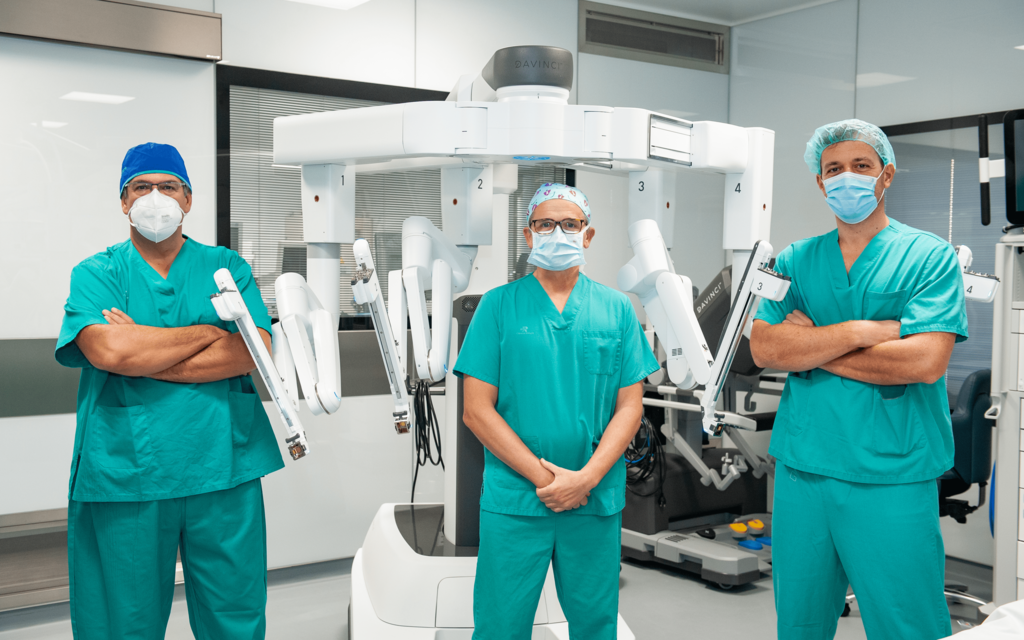
According to Dr. Guillermo Til, “The daVinci robotic surgical system allows surgeons to peñorrn safe, minimally invasive surgerywith fewer sequelae for the patient”.
The Da Vinci Xi robot at Clínica Rotger offers patients the most advanced surgical procedures with professionals who are experts in robotic surgery and leaders in each of their specialities, focused on offering the best guarantees in terms of patient safety.
This robotic surgery is an effective, more precise, minimally invasive procedure that is ideal for patients who cannot tolerate other treatments such as the use of CPAP. In addition, the intervention is performed through incisions inside the mouth so it leaves no externa signs on the skin.
The robotic arms perfect the doctor’s pulse and thanks to their ability to rotate 360° they allow access to anatomically complex areas, providing better guarantees in terms ofpatient safety in different surgical specialities such as Urology, Gynaecology, General Digestive Surgery and Otolaryngology.
